Design Thinking course with Federico Lozano
Translation of the original in Spanish. Read it in: CatalàCastellano
On 24 February at "la Salle" I had the opportunity to take a Design Thinking course; ever since I did the
this was a topic that kept going round and round in my head. So, I finally managed to make my first practical foray into the subject. The course lasted 12h and it was taught by
, a former student of the same university and with a spectacular CV; of Mexican origin and currently living in Norway and who, besides studying in Barcelona ("la Salle"), also had his triumphant spell at Stanford; it should be noted that he lived most of his childhood and youth in California.
If you have never heard of Design Thinking, we could summarize it as a methodology to generate innovative ideas. It focuses on providing solutions to real user needs. We could say it's the way designers think. It has its origin in the 70s at Stanford university. Design Thinking has become especially famous because big companies like Apple, Google or Zara use it to design their products; in essence it manages to find the convergence between user needs, what is technically possible and what is also supported by a viable business strategy.
Regarding my assessment of the course I'd say it has been a really interesting experience; the content has been impressive and the teacher's empathetic and educational ability has been fantastic. It's worth saying that I happened to share the course with a very cosmopolitan group of students with a very varied age range and that enriched it even more. For me the main point of improvement would be that it can't be a 12h course, it's impossible to convey such interesting things and do it in a practical way in so little time. So, I'm in favour of extending the syllabus a little with more examples and practical cases giving it more time; in my humble opinion more than double.
Briefly and totally constructively, another point of improvement would be: Federico, if the students arrive late I'm of the opinion of starting without them. Maybe first thing on the first day you can wait 5 or 10 minutes which then have to be made up. But we can't wait at every break for the "slow one of the day". Otherwise in the end the schedule can't be met because of the lack of formality of a few. I think not keeping to the hours can be a lack of respect towards those who do keep to what is established.
The structure of the course consists of giving a series of theoretical notions that are immediately applied in the form of different exercises that have a complete Design Thinking process as their common thread.
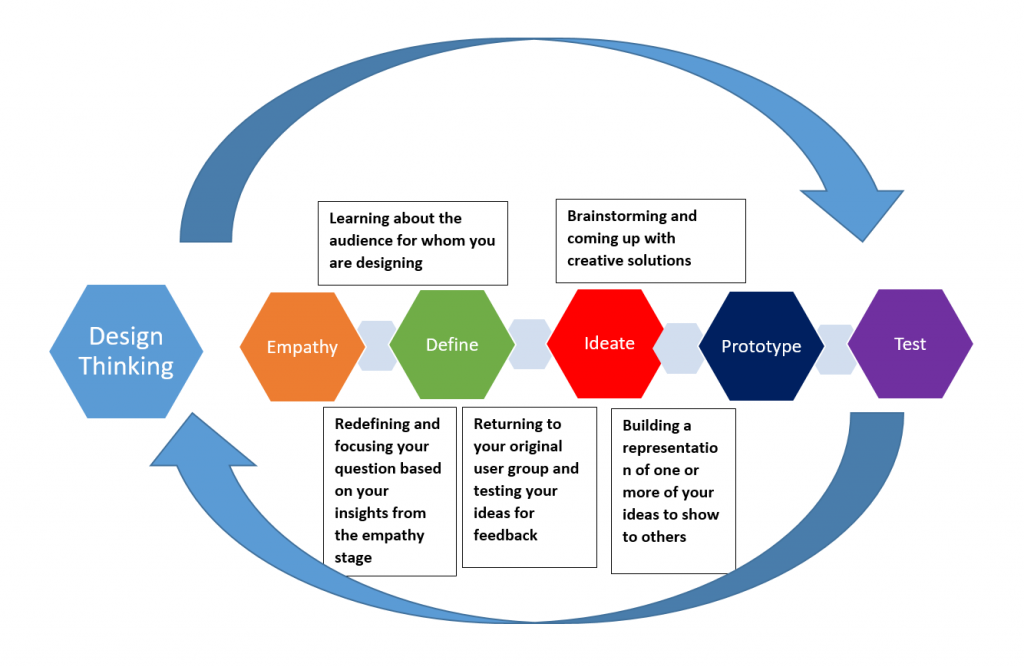
Like any good relationship the Design Thinking process starts with a phase of empathy in order to be able to understand and grasp the user's point of view. This part of the process we call empathetic exploration; it's about observing a great deal, interviewing the users and finally immersing ourselves in the user's habitat. Exercises like mirror questions; "A" asks "B" and then the same question is answered by "A". Besides the exercise of holding the gaze for 4 minutes in a row I think they're fantastic; below you have a video about this last exercise.
Once we have collected everything necessary from the first phase, the empathy phase. It's time to define, put another way, the synthesis of the design. It's about building meaning through visualization, manipulation, organization, pruning and filtering of data in order to produce information and knowledge. At this point of the process it's really important to highlight the empathy maps that will allow us to define the "person" who will be our user of the process. So the "outcome" of this point will be having defined a good point of view of the "person" who will be the object of our study. This will give us synthesis, focus, specific direction, a reminder and will be a good springboard for good ideas.
After the definition step, where we have been focusing; we diverge again now in the idea generation phase. As in any "brain storming" we must remember that we shouldn't judge any idea, we have to seek madness, be visual and the more ideas the better. Later we'll filter all this but from the point of view of the "person", not ours.
The ideas of the previous point are the basis for being able to converge again in this case in order to do rapid prototyping. Quality doesn't matter, the important thing is being able to go back and forth as many times as possible from this phase to the next one, the test phase. So the more prototypes and tests we do the simpler it will be to contrast with the real world whether our product makes sense or not for the "person" we had designed for.
This is my summary of the course, I hope it has been useful to you and if you're interested in the subject of product design I encourage you to try Design Thinking.