NLP: goals and neurological levels
My NLP notes on the logical and neurological levels, how to set a goal, meta-goals and TOTE.
Translation of the original in Spanish. Read it in: CatalàCastellano
Part 3 of 5NLP notes
These notes were in the oriolrius.cat wiki (2011–2012), across several pages of my NLP notes that I bring together here. I recover them as they were.
Logical and Neurological Levels
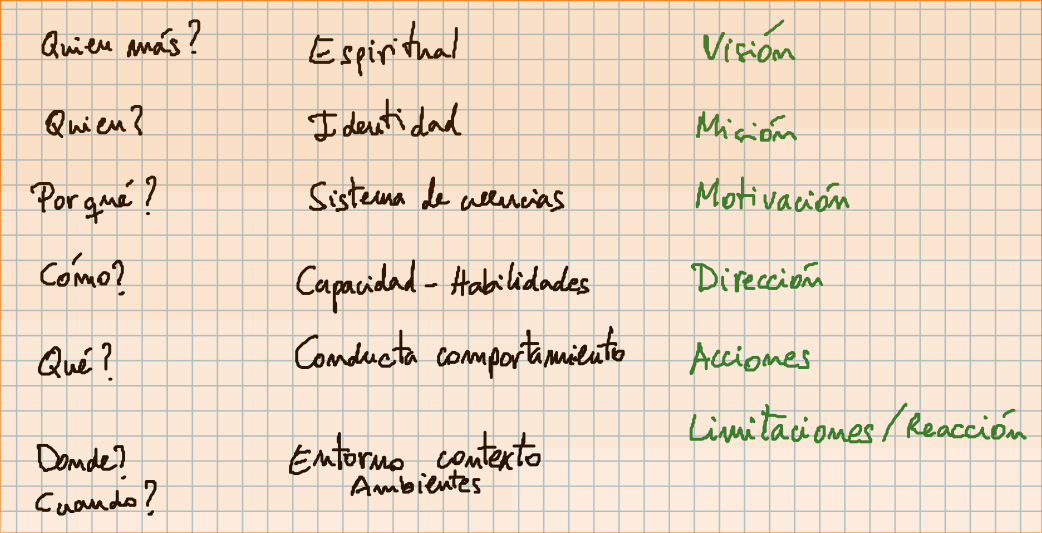
- Spiritual: who is above me? who is more important than me? connection with the Being, or Essential Being.
- Identity: who am I? what is my mission or function in life? identity emanates from spirituality. From who I believe I am come the limits.
- Beliefs: why do I do or would I do things? permission or motivation that leads me to do things. The most complex level: formed by the system of values, criteria, beliefs and metaprograms. The fixations and passions of the ego are born from groups of these beliefs. Our beliefs support identity and connect us with power: whether you believe you can or you believe you cannot, you are right.
- Capabilities: strategies, states, qualities, emotions. The How? How I do or how I prevent myself from doing. Internal states, which allow us or not to generate certain behaviours. This is the level where one can work most assiduously with NLP.
- Behaviours: What I do. Specific actions carried out in each context. Behaviours: operational, anomalous and even illnesses. For NLP illnesses are a behaviour.
- Environment: Where, when and with whom. External context. The success or uselessness of our behaviours will often be conditioned by the place, the moment and the company.
How to set a goal
NLP offers us a method to help us set goals.
- Start by defining your goal. Think more about what you want than about what you do not want
- Analyse whether it is you who wants to achieve it or whether it is another person's aspirations, and whether what you want to achieve is under your control
- Imagine the goal as precisely and concretely as possible. Answer the questions where? when? and how will you do it?
- Imagine how you will feel when you have achieved it and think about how you will know that you have achieved it
- Analyse whether you have the resources to achieve the desired results
- Make your goal the right size for you. If it is very big, divide it into parts so that it has the right difficulty to be motivating and achievable
- Think about the consequences of achieving your goals. Analyse the impact it will have for you and for others
The last step is to move to action. A purpose is the intention of making a trip, but to reach the destination it is necessary to set off in the desired direction.
Characteristics of a goal
- Specific
- Clear
- Realistic
- Challenging
- Measurable
- Divisible into stages
Meta-goals
What needs are you going to satisfy when you reach your goals? it is important to recognise what benefits you will obtain by achieving them, since this will generate a positive incentive to reach them. "Decide what you want, decide what you are willing to give in exchange. Set your priorities and get to work" H.L. Hunt
TOTE
- Goal
- How? and when?
- How will you know that you have achieved it?
- and if it fails?