podcast 1x08: CAS, Central Authentication Server
Translation of the original in Catalan. Read it in: CatalàCastellano
Part 8 of 13Podcast, season 1
- Podcast 1x01: The first podcast
- Podcast 1x02: Gentoo and the future of servers
- Podcast 1x03: why did I start the Blog?
- Podcast 1x04: coreutils problem, miroTV, animoto and Qik
- Podcast 1x05: complaining about everything a bit and podget
- Podcast 1x06: digikam, gallery2, machine tags, pfSense i Mikrotik
- Podcast 1x07: project management
- podcast 1x08: CAS, Central Authentication Server
- podcast 1x09: unified authentication system (single-sign-on)
- podcast 1x10: The solution to the Twitter problems
- podcast 1x11: networking challenge [the problem]
- podcast 1x12: mail-gateway (GatV2)
- podcast 1×13: networking challenge [the solution]
The aim of this podcast is to give a conceptual view of how CAS 2.0 works, an SSO (Single Sign On) authentication server. It is basically aimed at users of applications with a Web interface. At
we are using it as I mentioned in the
.
The difference between 1.0 and 2.0 is that version 1.0 could only authenticate users against web applications and these services could not in turn authenticate against other services (backend services).
With the diagram below and a prior reading of the entities of a CAS system you will be able to follow the podcast:
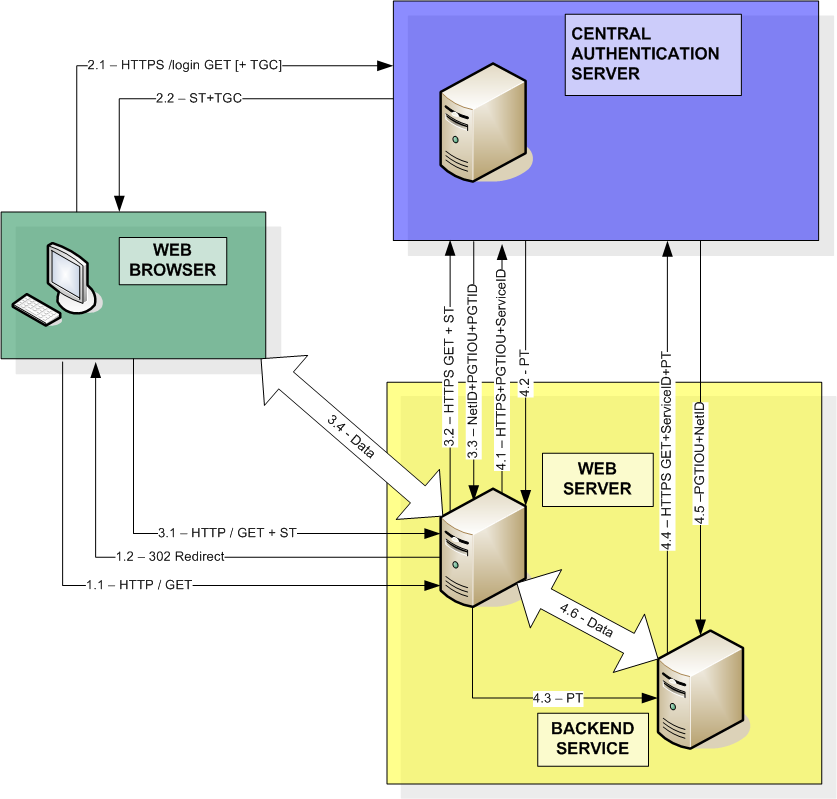
Below I describe the entities that take part in a CAS system.
- Service Ticket **** (ST): it is a text string that the client uses as a credential to gain access to a service. This ticket is obtained from the CAS server. The way to obtain it is through a cookie that is stored in the browser.
- Ticket Granting Cookie (TGC): cookie that is sent to the CAS when a browser has already been authenticated previously by this CAS, then it recognises the cookie and gives the browser a Service Ticket (ST) without having to go through the manual authentication process. It expires in about 8h.
- NetID: identifies a user, what we usually know as username.
- ServiceID: identifier of a service, normally in URL format.
- Proxy Ticket (PT): it is another text string that a service uses as a credential to gain access to a backend service. That is, the first service in order to carry out its activity needs to access another service (backend service); in order to gain access to this last service the first one will use a proxy ticket. These tickets are obtained from the CAS when the service that wants access presents a PGT (Proxy-Granting Ticket) and a service identifier that refers to the backend service.
- Proxy-Granting Ticket (PGT or PGTID): it is another text string that, as we have seen in the previous point, the service uses to get a Proxy Ticket (PT) that gives it access to a backend service; access to this service will be with the same credentials as the original user, that is, the one who has authenticated to the first service.
- Proxy-Granting Ticket IOU (PGTIOU): as it could not be otherwise, it is a text string that is passed as the response of serviceValidate and proxyValidate used to correlate a Service Ticket or a Proxy Ticket validation with a particular Proxy-Granting Ticket (PGT).
Now all that is left is to listen to the podcast:
The links related to the podcast:
NOTE
: thanks to Marc Torres for his work, thanks mate.
5 comments
Comments from the old blog, as they were written. Comments are closed.
Friki
Ei! Quan miro d'obrir el podcast dona "Error opening file"!
Gracies!!!
Oriol Rius
Solucionat, gràcies per avisar. Tenia un petit error sintàctic en la ruta del fitxer. Errors de no fixar-s'hi i anar massa ràpid.
rafalito el melocoton
La músiqueta de fons esta un pel forta.
Mol interesant per xo
Oriol Rius
Corregit el tema de la música, l'he abaixat 10dB.
mTorres
Ei la veritat és que CAS és força complicat d'ententre a primera vista. El tema del proxying i tal no és trivial i t'ho has de mirar bé per pilllar-ho, però la veritat és que t'ha quedat ben explicat :-)
L'esquema t'ha quedat 20 vegades millor que el meu :-p
Salut!
PD: Ara la música está perfecte!