Home audio system (MPD player)
Translation of the original in Catalan. Read it in: CatalàCastellano
My intention is not to write another super technical article with configuration files and very technical details. Although this is the description of a technical project, I do not think it has any difficult point, so I will focus more on the descriptive and philosophical side of what I am trying to achieve.
Well then, the idea is to set myself up with a somewhat better system for listening to music at home, both in the study (where the PCs are) and in the rest of the house. That is why I made a small diagram of what I put together this weekend.
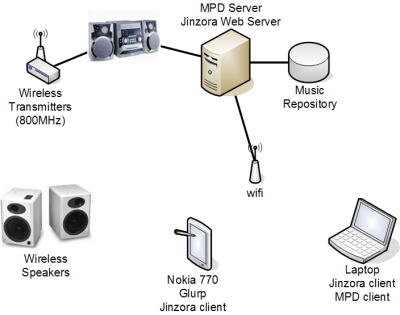
The idea is to take advantage of the fact that the server has a sound card and holds the main music repository. The player I have installed on it is a bit special, it is called MPD (music player daemon). Basically its trick is that it runs as a daemon and that it allows receiving remote commands through a TCP socket. Therefore, I will be able to remotely control what is playing through client programs.
Besides, thanks to jinzora, an application over the web, I can browse all the available music with all the information of the music in the repository and through the interface I can send new playlist or on-demand music to the MPD server. It really is an impressive application, highly recommendable. If you do not have an MPD server it can also send the music through streaming to the user's player and, if the bandwidth is not too good, it allows doing transcoding in real time.
Well then, with just this I can already put on music from any device that lets me access the web interface of jinzora. Because if you run it in jukebox mode it allows throwing the music directly at the MPD. Moreover, those queues of music to be played are not kept by jinzora but by the MPD, so when we connect with an mpd client we will be able to see the song that is playing, the queue, pause, stop the music, change the volume of the server, etc.
To the audio output of the server's sound card I have connected the mini hi-fi and, when I want, to the output of the mini hi-fi I connect the Rimax audio transmitter, the one I bought in January last year (it works over UHF at 800MHz). That way the speakers (receivers) on the ground floor also start playing the music from the study.
Now, taking advantage of the fact that I have wifi coverage all over the house, I have configured on the nokia 770 a program called glurp, also available for PC. It is an MPD client. It is very light and fast, bear in mind that it only acts as a frontend and it allows keeping our playlists on the server, retrieving them whenever we want and creating new lists in a very simple way. I have this client installed on the laptop as well, it works very well.
So, with four tools and a bit of patience configuring and testing, I already have a more or less decent audio system. Obviously it can be improved a lot. In fact, the idea I have in my head would be something like this:
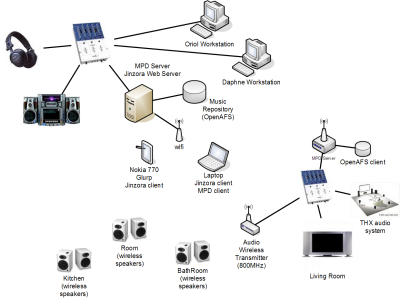
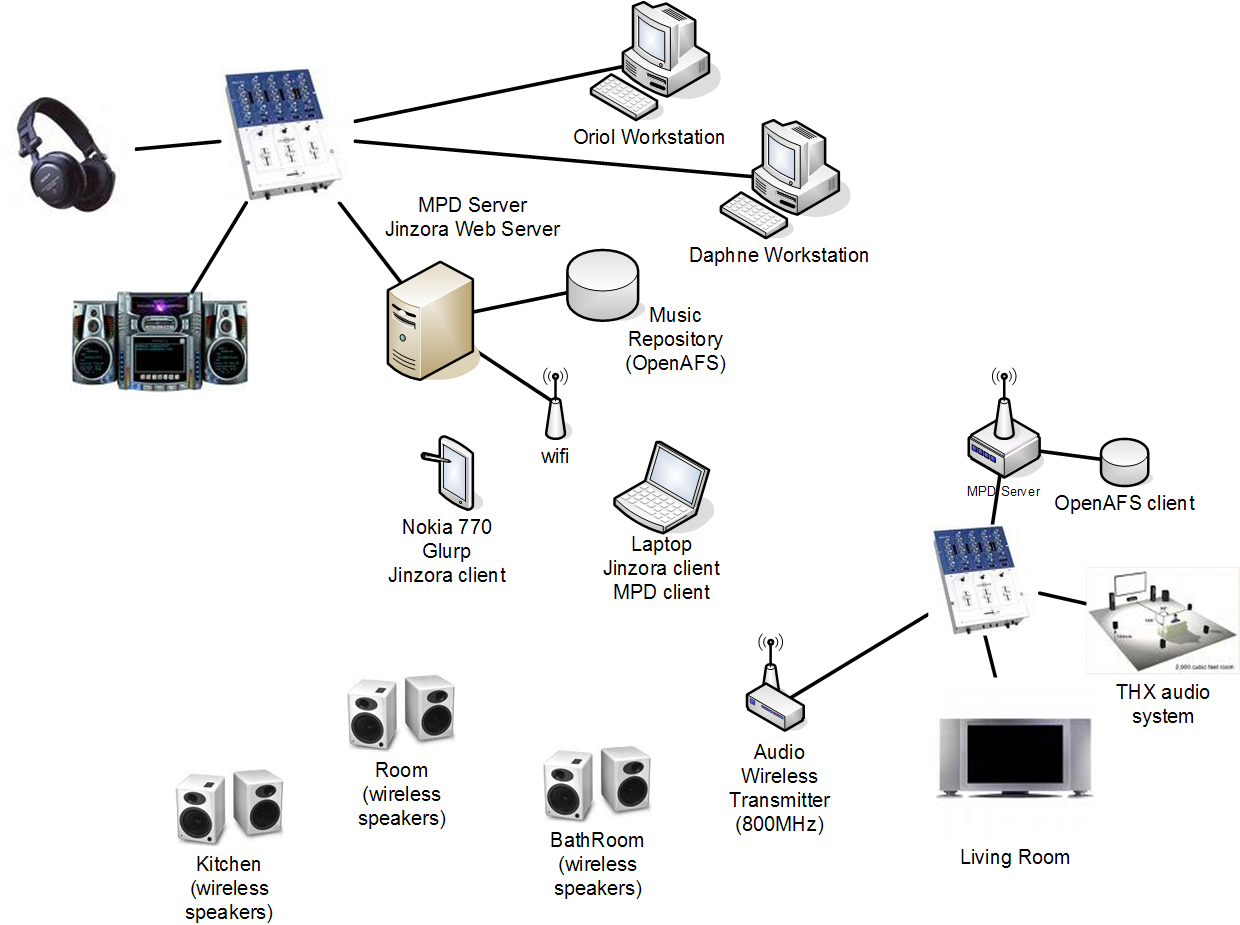
Basically it is about extending the areas where there are wireless speakers, and also about placing a couple of mixers, digital if possible, both in the study and in the dining room. In order to be able to control the volume of all of it in a centralised way. I would also like to finally start setting up the media center of the dining room. With the MPD with a mirror of the repository mounted through openAFS and synchronised over wifi.
Also the mixer of the study should allow capturing the audio outputs of both PCs, being able to route the sound to the mini hi-fi or to the headphones, so if Daphne starts studying Chinese it does not bother me while I listen to music or simply work without music. I have seen that there are mixers of this kind that are called matrix but they are not controlled via soft, but through a console like a remote control with a small screen. Let's see if I find one that lets me do it via soft.
A pending topic I have not tackled yet is supporting streaming from the internet. In fact, it is nothing out of this world, but I was turning over which functions could interest me in this system and the truth is I cannot find any, since lately I do not listen to much on the internet.
I was also turning over making the MPD servers take the music from an internal streaming server (shoutcast) and that way both players would produce the same sound and both in the study and downstairs the same would be heard. But I have not found that too important either and that is why I have not got into it.
Now I still have another article pending, which would be a complementary article to this one, where I will tell you about commercial products and other 'inventions' that allow extending this idea I explain here. But for today I have written enough... I am off to work.
4 comments
Comments from the old blog, as they were written. Comments are closed.
amanya
Hola Uri!
Caram, fa uns dies que em vaig apuntar aixó de l'mpd a la cua de coses per fer...
Una pregunteta, es que a la ràdio fem servir un programa per preparar les cançons que han de sonar durant tot el dia, setmana i que te unes funcionalitats pensades per a ràdios com ara intercalar falques de publicitat, fer una gestió una mica intel·ligent de les pistes de música per tal que no soni la mateixa cançó cada dia a la mateixa hora i per no barrejar estils de música, etc...
Aquest programa és comercial, i ens trobem que no podem fer les coses que a nosaltres ens agraden ;) com exportar la llista de reproducció per penjar a la web, programar-lo una mica per poder demanar cançons online, etc.
La pregunta és: et sona algun projecte per l'estil? Les meves recerques han estat infructuoses fins ara... Alguna cosa com el jinzora peró enfocat a les ràdios...
Apa, salut!
—
[1]
Bé doncs jo la veritat és que no coneixo res tan específic. Però no seria difícil fer un programet en PHP, o qualsevol altre llenguatge, que ataqués directament a l'MPD i donés totes els funcions que tu demanes. Per altre banda a la web d'MPD tens molts exemples en diferents llenguatges perquè vegis el senzill que és atacar el serivdor TCP del MPD.
Ho sento però no coneixo més a fons el tema.
—
A bulma pocs dies després de publicar jo aquest article, també van publicar un article molt semblant però més orientat als detalls tècnics:
MPD: un esquema diferente para un reproductor de música
—
La idea de l'icecast que comento a l'article, és gairebé el mateix que s'explica en aquest article:
Using MPD and Icecast to stream audio