Dynamic buffer systems (Why does Win get slower and slower?)
Translation of the original in Catalan. Read it in: CatalàCastellano
We have all noticed that the windows are O.S. (to put it some way) that keep degenerating more and more... so much that in the end they become unusable. Well, this ends up turning into a mystery and even more so if the system in question is a system where no new software has been installed. Where you always work with the same applications and where, since nothing has been touched, not even the periodic updates that come out on WindowsUpdate have been done.
Surely this mystery has multiple reasons to be, but specifically looking at the specifications of the cards from the people at Custodius (commented on in this article) they give us a solution to one of the problems of this slowing down we were talking about. The document explains the problem of static buffers. Trying to solve the problem through a system of dynamic buffers implemented in hardware. I leave you in the body of the message the technical argument and the solution that these people implement on the subject and also the original link you have here.
If we analyse a hard disk with the defragmenter, we find different parts of the disk written with different information and "gaps" between all these written sectors..
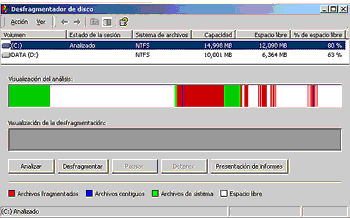
The TRADITIONAL BUFFER system looks for the space between the last written sector and the end of the disk to place itself (between 500 Mb. and 1 Gb.). This often forces you to defragment the hard disk, especially when the installation is done on PCs that have been running for some time.
In some operating systems (especially the more modern ones) it is common to find sectors written by the system itself at the end of the disk, which means the space left to install the BUFFER is small and its limited capacity can reduce the performance of the system. These written sectors do not move with a simple defragmentation, sometimes even tools such as H-POWER (included in driver version 1.64), which have been designed especially to move these sectors, are unable to do so.
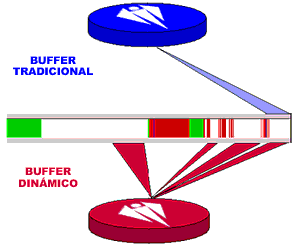
The new DYNAMIC BUFFER is configured with the "gaps" that the hard disk has between the different written sectors, this way, defragmentation, although always advisable, is not essential. The DYNAMIC BUFFER allows you to ALWAYS get the best performance from your CUSTODIUS protection system.
This type of BUFFER has been incorporated into the models CIBERNIA, LITE 2004, PROFESSIONAL 2004 AND ENTERPRISE 2004.